AI Terminology
Physical AI
Physical AI vs Embodied AI vs Robotics AI: What's the Difference
Six comparison tables exist for this question and none agree. The reason is a type error, and NVIDIA's own glossary proves it.
 9 September 2026
AI Terminology
Physical AI
Six comparison tables exist for this question and none agree. The reason is a type error, and NVIDIA's own glossary proves it.
9 September 2026
Author: Jesal Thakkar, Founder & CEO, FutureBeeAI · Reviewed by: Praveen Kumar, Founder FutureBeeAI
Last updated: 11/09/2026
You've probably read this explanation twice already, and the two versions didn't agree. That isn't your memory playing tricks on you.
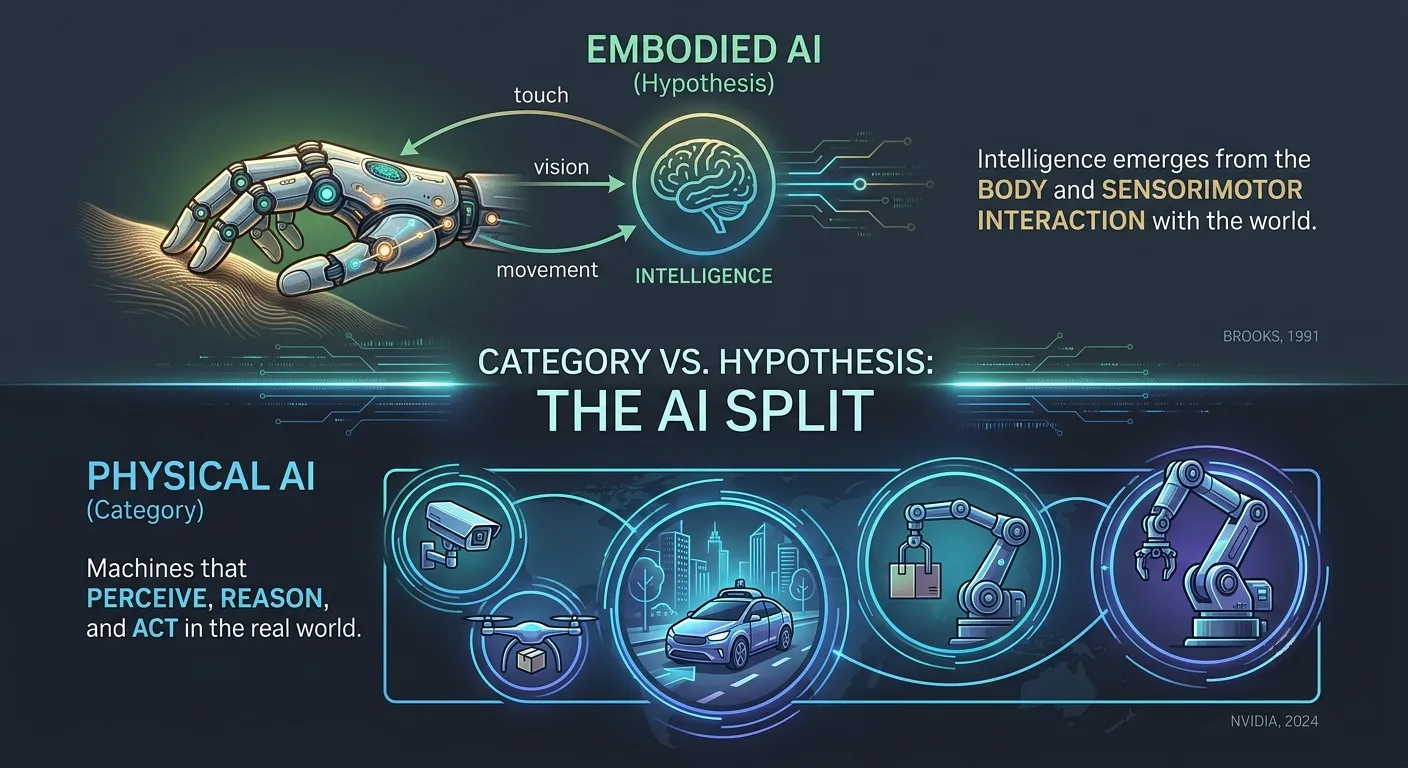
Embodied AI is a research hypothesis, roughly thirty-five years old, holding that intelligence requires a body and emerges from sensorimotor interaction with the world. Physical AI is an industry category, popularized from 2024, covering machines that perceive, reason and act in the real world. The two are not competing definitions of one thing.
They're different kinds of words, which is why every comparison table you've found says something different. This piece explains the disagreement instead of adding a seventh opinion to it.
In everyday industry use, yes. Treat them as interchangeable in conversation, in a pitch deck or in a market overview, and nobody competent will correct you, because most of the field uses them that way.
In precise use, no. But the difference isn't the one the comparison tables claim. It isn't that one is broader, or that one implies a robot body and the other doesn't. It's that the two words are doing different jobs in a sentence, and once you see which jobs, the confusion resolves permanently.
That distinction carries a cost, and the cost shows up in a data specification rather than a glossary. That's the part worth staying for, because it's what turns a vocabulary argument into a line item.
Search this question and you'll find at least six comparison tables. None of them agrees with another on the fundamental relationship.
One camp says the terms are synonyms outright. A second says embodied AI is a subset of physical AI, so all embodied AI is physical AI but not the reverse. A third presents them as parallel paradigms with different theories of intelligence, one about completing tasks and one about developing understanding. A fourth argues they differ by axis rather than scope: physical AI describes what a system does, embodied AI describes what shapes its intelligence.
A robotics professor quoted in the trade press offers a fifth position entirely, that the dividing line is whether the system must operate in real time.
Every one of these is asserted. Not one is argued from evidence. So the confusion isn't yours.
If six independent sources disagree, the obvious move is to check with whoever coined the newer word. That turns out to help less than you'd expect.
NVIDIA popularized "physical AI" and maintains two separate glossary pages.
The physical AI page: "Physical AI lets autonomous systems like cameras, robots, and self-driving cars perceive, understand, reason, and perform or orchestrate complex actions in the physical world."
The embodied AI page: "Embodied AI refers to the integration of artificial intelligence into physical systems, enabling them to interact with the physical world."
The physical AI page never defines 'embodied', the word surfaces once, as a modifier in a product sentence about Cosmos, and NVIDIA has not published a statement of how its two terms differ.
This takes thirty seconds to verify, and it matters more than any vendor table. Every article citing NVIDIA as the authority that separates these terms is citing something that doesn't exist.
If the source of the newer word can't separate the two, the separation has to come from somewhere else. It comes from how old each word is.
Most people assume both terms are recent. One of them isn't.
The Association for Computing Machinery's own history of the field traces embodied artificial intelligence to Rodney Brooks in 1991, arguing that intelligent behavior could arise directly from a machine's simple physical interactions with its environment rather than from internal symbolic representation. Rolf Pfeifer and Christian Scheier developed it in 1999. Linda Smith introduced the embodiment hypothesis in 2005.
By 2021 it had formal survey literature, framing embodied agents as systems that learn through egocentric interaction rather than from curated internet datasets.
This is the part that changes how you should read the word. Embodied AI isn't branding. It's a research program making a claim that could turn out to be wrong.
NVIDIA's physical AI glossary page was created in July 2024. At CES in January 2025, Jensen Huang described the arrival of "the era of physical AI, AI that can proceed, reason, plan and act."
There's one genuine academic precedent. Miriyev and Kovač published on physical artificial intelligence in Nature Machine Intelligence in November 2020, four years earlier. Be careful with it, because it means something different again, closer to the synthesis of robot bodies and materials than to NVIDIA's usage.
So the honest comparison is between a term with thirty-five years of literature and critics, and a term with two years of adoption and a keynote. That asymmetry is the whole story. It also explains why the research community never adopted the newer word: the survey papers on embodied AI published through 2024 don't use "physical AI" anywhere.
Age alone doesn't settle which word you should type, though. What settles it is noticing that the two aren't the same kind of word at all.
None of the six tables says this out loud, so here it is.
Embodied AI is a hypothesis. It makes a claim about how intelligence works: that it requires a body, and emerges from sensorimotor coupling with an environment. A hypothesis can be right or wrong. It has evidence, literature, and people who disagree with it.
Physical AI is a category. It draws a boundary around a class of systems so that people can talk about them as a market. A category can't be right or wrong. It can only be useful or useless.
You can't put a hypothesis and a market category in two columns of a table and ask which one is broader. The question is malformed. Six people asked it and got six answers, which is exactly what a malformed question produces.
A frame is only worth having if it predicts. So test this one against the disagreement it claims to explain.
The sources saying embodied AI is a subset are treating both words as categories. Compare two categories and you get a scope answer, so subset is what falls out.
The sources presenting two rival paradigms are treating both words as hypotheses. Compare two hypotheses and you get a philosophical answer, so competing theories of intelligence are what falls out.
The sources saying synonyms are looking at what the words point at in the world. Both point at robots, so synonyms are what falls out.
The fourth camp, physical AI as what a system does against embodied AI as what shapes its intelligence, had already half-named the split without the frame that makes it land.
Every camp is right about the thing it examines. Every camp is wrong that it answered the same question as the others.
That accounts for two of the three terms in the title. The third one is a different problem entirely.
It isn't a term.
There's no academic definition, no standards-body definition, and no industry definition. Searches return a Wikipedia disambiguation page, a vendor glossary, and the title of a journal call for papers. The established phrasings are "AI in robotics" or "robot learning." Not one of the pages currently ranking for the physical-versus-embodied question has a reader FAQ asking about robotics AI.
It's a phrase people type into search engines, not a concept anyone holds.
Which completes the picture rather than spoiling it. Three terms, three different kinds of object: a hypothesis, a category, and a search query. No wonder a three-column table has never worked. Two of the columns were never the same type of thing, and the third was never a thing at all.
Every existing table compares these terms on scope, asking which one contains the other. Scope is the wrong axis, for the reason the last two sections established: you can't rank a hypothesis and a category by breadth, because breadth isn't a property they share.
So compare them on what kind of thing each one is. That axis they do share, and it's the one that tells you how to use them.
One caveat before you read it. The middle column describes a category, so its rows answer differently in kind from the first column's rows. That's the point rather than a flaw in the table. Read the bottom row first if you're here for the practical answer. It's the row that changes what you write in a brief, and the only row where getting the term wrong costs money rather than credibility.
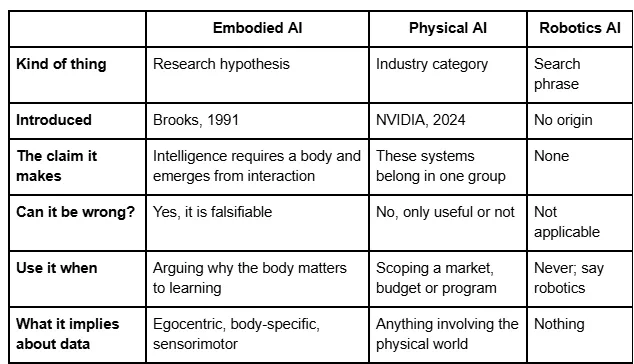
This table is a reading aid, not proof that the two are comparable on the same axis.
The table tells you what each word is. The practical question is which one you should actually type.
Use the category word when you're scoping. "Our physical AI program" is correct, because you mean the class of systems and their budget. Nobody will misread it.
Use the hypothesis word when you're making a claim. "This is an embodied AI problem" says something substantive: that the system's body and its interaction with the world are central to how it learns, and that you can't solve it with third-person observation. That sentence is an argument, not a label.
Use neither when you mean robotics. Say robotics.
Three worked cases. In a job requisition, write physical AI, because candidates search the category. In an architecture document, write embodied AI where you're justifying a design choice about sensors and viewpoint, which is the same reasoning that shapes how a vision-language-action model is built. In a vendor RFP, write neither and specify what you need, for the reason in the next section.
Vocabulary arguments are cheap until the word enters a data specification. Then it costs money.
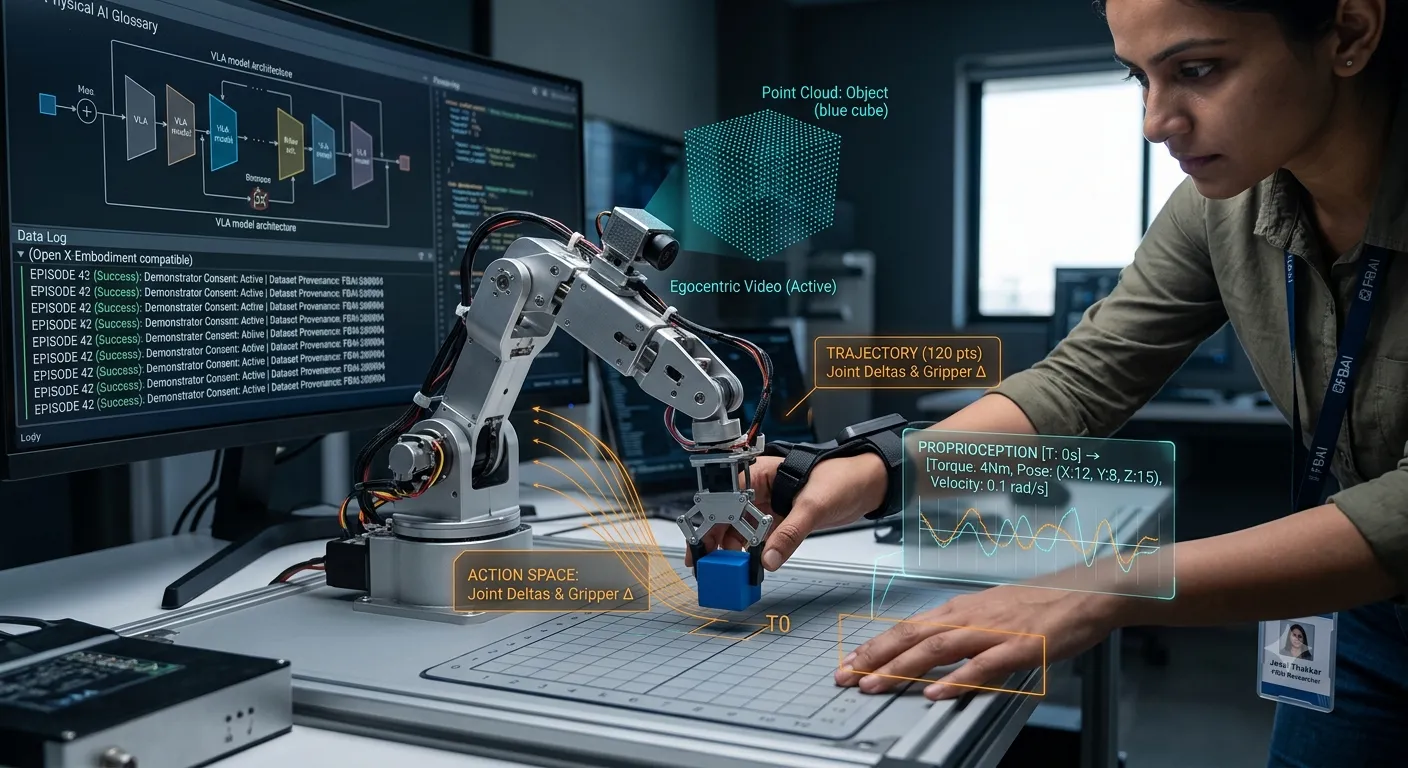
Ask a vendor for embodied AI data and the precise reading is that sensorimotor coupling is the point: egocentric viewpoint from a specific body, proprioception, force and torque readings, this gripper and this reach envelope. Ask for physical AI data and the category is satisfied by third-person video of things happening in the world.
Those are different collection rigs, different annotation taxonomies and different costs. Both are legitimate. Only one matches what you meant.
The asymmetry runs one way, which is what makes it dangerous. Third-person video can't be upgraded into embodied data later, because the proprioception and force channels were never recorded and the viewpoint was never on the body. Embodied capture, by contrast, contains third-person coverage as a byproduct if you rigged for it.
In FutureBeeAI's collection work, terminology mismatch surfaces at the point of the first delivery review rather than at briefing, because a brief written in category language reads as complete until someone tries to train on the result and finds no proprioception channel and no consistent viewpoint. The rework is a re-collection, not a re-annotation.
Which is why the fix has to land in the brief, before anyone quotes on it.
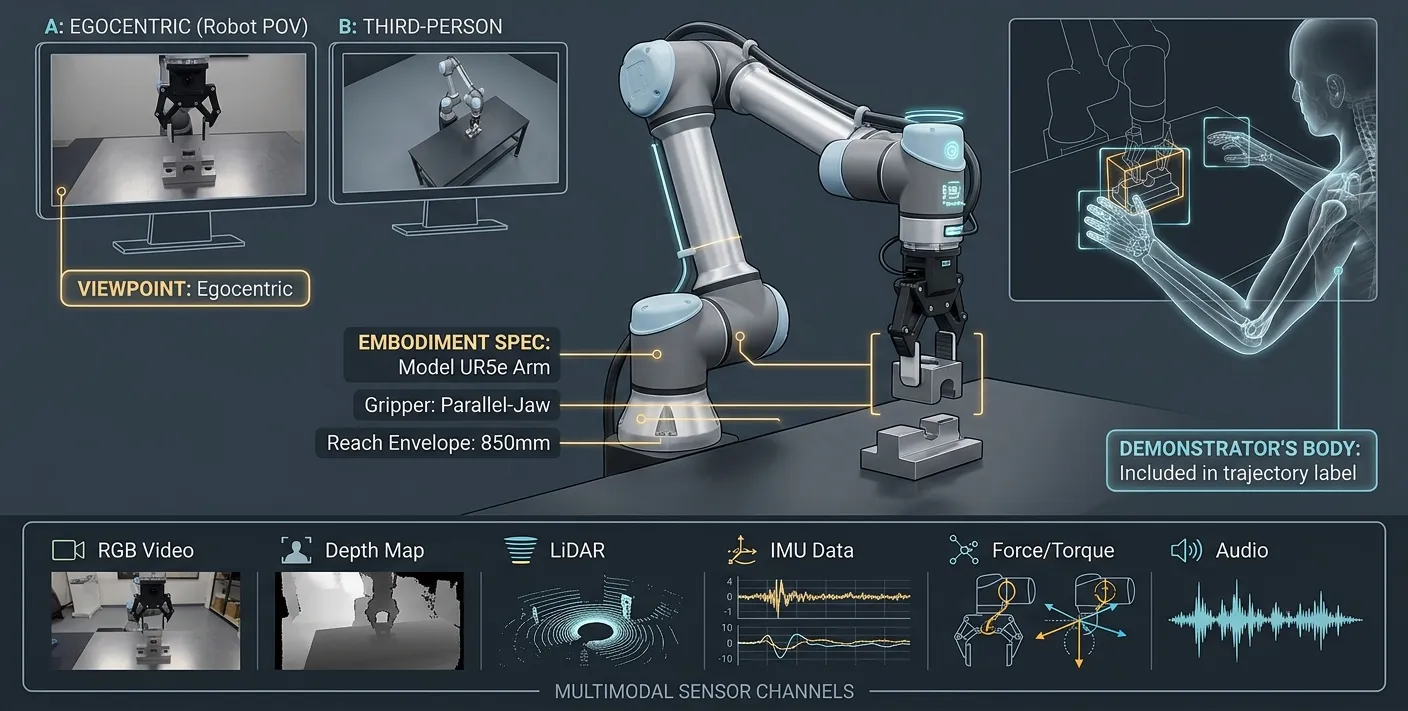
The fix isn't choosing the correct term. It's not leaning on the term at all.
These four lines live at the data layer of the physical AI stack, and specifying them makes the ambiguity disappear.
Viewpoint: egocentric from the robot, or third-person observation.
Embodiment: which hardware, which envelope, which gripper, or none at all.
Sensor channels: RGB, depth, LiDAR, IMU, force and torque, audio.
The demonstrator's body in the label: whether it forms part of the annotation, because that single line decides whether you're buying video or trajectories.
A brief written that way survives any terminology drift, including drift that hasn't happened yet. It also gives the vendor something to price accurately, which tends to surface scope disagreements during quoting rather than during delivery. If you're scoping this kind of collection, coordinated multi-sensor capture is what multimodal data collection is built for.
Which leaves one question worth closing on: how long any of these words will last.
You can now do something the six competing tables couldn't equip you for. You can explain to a colleague why the sources disagree, and defend a naming choice in a document that circulates.
Expect the words to keep drifting. One of them is a research program and the other is a market, and markets rename things when the naming stops selling. Physical AI is two years old, and the term after it is probably already being drafted in somebody's keynote. Meanwhile embodied AI will still mean what Brooks meant in 1991, because hypotheses don't get rebranded.
That's the real lesson, and it outlives this particular argument by some margin. Specify what you mean. Don't trust the label to carry it, because the label is the one part of your brief that somebody else controls.
If you're scoping a collection where that specification matters, talk to the FutureBeeAI team about how the capture gets designed before it gets quoted.
A. A fixed camera system that detects a defect on a production line and triggers a diverter arm elsewhere. It perceives the physical world and causes physical action, so it sits inside the physical AI category. It isn't embodied in the research sense, because nothing about its intelligence depends on having a body that moves through the environment and learns from that movement. The perception and the actuation are separate systems.
A. Three compounding reasons. Sensor input arrives continuously from multiple synchronized streams rather than as discrete prompts. Inference must complete inside a control loop, often in milliseconds, because the world doesn't pause. And training increasingly involves simulation, which means rendering environments as well as running the model. A text model answers when ready; a physical system that answers late has already collided with something.
A. No, and the difference is where the action lands. Agentic AI describes systems that plan and take actions autonomously, but those actions are typically digital: calling tools, querying databases, sending messages. Physical AI acts on matter. An agent that books a flight and a robot that picks up a cup share a planning structure, but only one of them can break something. Some systems are both.
A. In writing and conversation, rarely. In a procurement document, yes. The two words imply different data: embodied points to egocentric, body-specific capture with proprioception and force readings, while the physical AI category is satisfied by third-person video. A vendor reading one word when you meant the other delivers something that matches your brief and not your intent, and the correction is a re-collection rather than a relabel.
A. There's no single clean origin. NVIDIA drove mainstream adoption from 2024 onward, with a glossary entry created that July and Jensen Huang framing "the era of physical AI" at CES in January 2025. An earlier academic use exists, Miriyev and Kovač in Nature Machine Intelligence in November 2020, but it addresses the synthesis of robot bodies and materials rather than the class of systems NVIDIA describes. The two usages are not continuous.
Acquiring high-quality AI datasets has never been easier!!!
Get in touch with our AI data expert now!

 Share this article on