Author: Jesal Thakkar Founder, FutureBeeAI ·
Reviewer: Praveen Kumar Co-Founder, FutureBeeAI
Last updated: 27/10/26
A loan model passes every accuracy benchmark the team sets. Six months after launch, an internal audit finds it approves applicants from one region far less often than equally qualified applicants elsewhere. Nobody wrote a biased rule. The model simply learned from historical data that barely represented that region. The team now has to explain the decision to a regulator, retrain the model, and win back customers who were turned away. That’s what a loss of trust in AI systems actually costs: not a headline, but months of rework and a product people no longer believe.
Why does this matter more now than when we first wrote about it in 2023? Because AI has moved from pilots into decisions that touch money, health, and hiring, and regulation has caught up. The NIST AI Risk Management Framework now gives teams a shared vocabulary for trustworthy AI, and the EU AI Act puts data governance requirements on high-risk systems. Trust has stopped being a values statement. It’s now something you have to show.
Why Trust in AI Systems Starts Before the Model Is Trained
Most conversations about trustworthy AI focus on the model: its architecture, its guardrails, its evaluation scores. Those matter. But almost every trust failure we see traces back to a decision made earlier, when someone chose what data to collect, who to collect it from, and how to label it.
Think of it this way. A model can only be as fair as the population its data represents, only as explainable as its labels are consistent, and only as private as the collection process allowed. You can add checks after training, but you can’t add back what the data never contained.
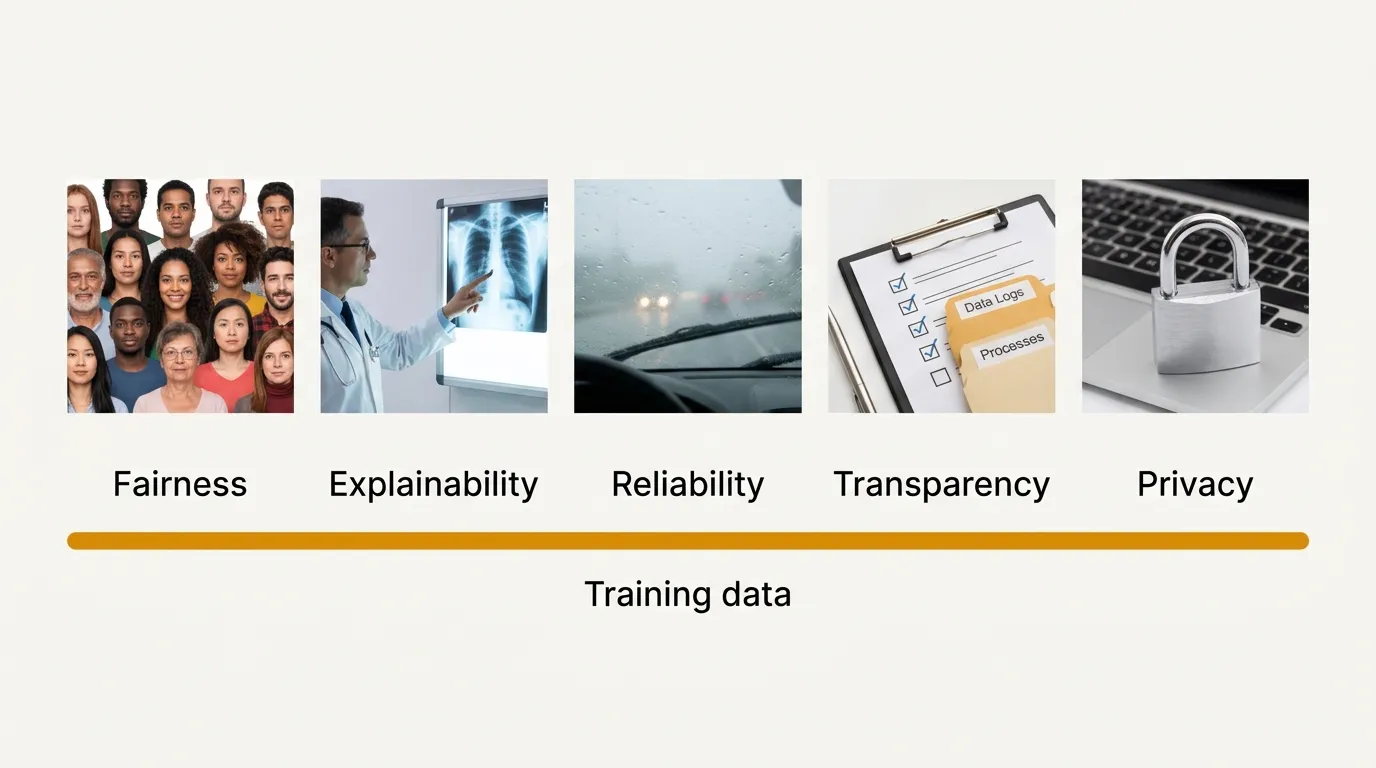
So let’s walk through the five pillars, starting with the one that fails most visibly.
Pillar 1: Fairness Is a Coverage Problem First
A fair AI system treats people and groups equitably, which sounds like a model property. In practice, it’s mostly a data property. The landmark Gender Shades study found that commercial facial analysis systems had error rates of up to 34.7% for darker-skinned women, compared with 0.8% for lighter-skinned men. The models weren’t designed to discriminate. They were trained on data that underrepresented some faces.
The same pattern shows up in speech, text, and documents. A voice assistant trained mostly on one accent will mishear everyone else. A support chatbot trained on formal English will struggle with code-mixed messages. We’ve written before about why training data diversity matters, and the point holds even more strongly today: fairness has to be designed into the collection plan, with clear targets for age, gender, accent, region, and device.
Fairness also needs ongoing checks. Auditing outputs by subgroup, before launch and on a schedule after it, is how you catch the gaps your collection plan missed.
But a fair outcome isn’t enough on its own if nobody can explain how the model got there.
Pillar 2: Explainability Depends on Consistent Labels
Explainability means a system can give a clear reason for its decision. A medical imaging model that highlights the region behind its diagnosis gives a clinician something to check. A model that only returns “positive” asks for blind faith, and most clinicians won’t give it.
Here’s the part that often gets missed. Explanation tools show what the model learned from its labels. If annotators disagreed about what counted as a lesion, or labeled the same pattern three different ways, the model’s explanations will reflect that confusion. You’ll see heatmaps that point at the wrong thing, and you won’t know whether the model or the data is at fault.
That’s why annotation guidelines, calibration rounds, and agreement checks are trust work, not just quality work. Expert-led annotation with documented guidelines gives you a label set you can stand behind when someone asks why the model decided what it did.
Clear reasoning helps on a normal day. The harder test is what happens when the day isn’t normal.
Pillar 3: Reliability Is Decided by What the Model Has Never Seen
A trustworthy system keeps performing when conditions change: a noisy call center, fog on a camera lens, a scanned invoice at an odd angle. It also has to hold up when someone tries to fool it. Research on adversarial examples showed that changes too small for a person to notice can push an image classifier into a confident wrong answer.
Most reliability failures, though, aren’t attacks. They’re ordinary conditions that the training data never covered. A speech model collected in quiet rooms fails in cars. A vision model trained on daytime footage fails at dusk. The fix is to collect for the conditions your users actually live in, including background noise, lighting changes, device variety, and real edge cases, not just the clean examples that are easy to gather.
This is where custom data collection earns its cost. When you define the environments, devices, and edge cases up front, reliability becomes something you planned rather than something you hope for.
Of course, even a reliable system loses trust if its users can’t see what it was built on.
Pillar 4: Transparency Means You Can Trace Your Data
Transparency is about telling users and regulators what a system can do, where it falls short, and what it was trained on. Practices like Datasheets for Datasets and model cards made this concrete: document the data’s origin, composition, collection method, and known gaps, so others can judge whether the model fits their use.
Regulators now expect the same. The EU AI Act asks that training, validation, and testing data for high-risk systems be relevant, sufficiently representative, and as free of errors as possible. You can’t prove any of that if you don’t know where your data came from. We covered this in more depth in our piece on AI traceability and governance.
In practice, transparency means metadata on every data point: who contributed it, under what consent, in which conditions, and how it was labeled and reviewed. FutureBeeAI captures this through its Yugo platform, so documentation is a byproduct of collection rather than a scramble before an audit.
If you’re preparing documentation for a regulated use case, talk to the FutureBeeAI team about what a traceable dataset should include.
And the most sensitive part of that record is the personal data inside it.
Pillar 5: Privacy Has to Be Built Into Collection

Privacy is where trust can be lost fastest. Users who learn their voice, face, or medical history was used without their knowledge rarely come back. The principles are well known: collect only what you need, remove identifiers, encrypt data at rest and in transit, and respect regulations like GDPR and HIPAA. In healthcare, for example, the HHS guidance on de-identification sets out how protected health information can be stripped before data is used.
What gets less attention is consent. Privacy controls protect data after you have it. Consent decides whether you should have it in the first place. Contributors should know what they’re recording, how it will be used, and how to withdraw. Our guide on how informed consent works in AI data collection walks through what that looks like in practice.
There’s also a quality argument here, not only an ethical one. Consented, fairly paid contributors who understand the task produce cleaner, more consistent data than anonymous workers paid by volume. Ethical sourcing and data quality turn out to be the same investment.
Knowing the five pillars is one thing. Spotting where they break in a real pipeline is another.
Where Trust in AI Systems Usually Breaks
The standard practice in much of the industry is to treat trust as a review step at the end: build the model, then run a bias check, then write the documentation. By that point, the data decisions that shaped fairness, reliability, and privacy are already locked in. Fixing them means collecting again.
If you’re evaluating your own pipeline or a data partner, here’s what to look for.
Red flags
No demographic targets: Nobody can tell you who is in the dataset or who is missing.
Clean-room data only: Recordings or images were captured in ideal conditions that don’t match real use.
Unmeasured label agreement: Annotation is done, but nobody has checked whether two annotators would label the same item the same way.
No consent trail: The source of the data, and whether contributors agreed to its use, can’t be traced.
Green flags
Coverage plans up front: Targets for language, accent, age, gender, region, and device are set before collection starts.
Real-world conditions: Data includes the noise, lighting, devices, and edge cases your users will bring.
Calibrated annotators: Guidelines are tested on pilot batches and agreement is tracked throughout.
Documented provenance: Every data point carries consent records and collection metadata.

So what does it look like when a team builds trust in from the start?
How to Build Trust in AI Systems From the Data Up
The teams that get this right treat trust as a data requirement, written into the project plan alongside accuracy targets. Here’s the practical approach:
1. Write trust requirements before collection: Define which groups, languages, and conditions the model must serve, and turn them into collection targets.
2. Source from real people with real consent: Native speakers and domain contributors, recruited with clear consent, give you data that’s both representative and defensible. FutureBeeAI’s crowd community spans 100+ languages and 70+ countries for exactly this reason.
3. Measure label consistency, not just label volume: Agreement scores tell you whether your explanations will mean anything later.
4. Document as you go: Capture metadata at the point of collection so audits and datasheets draw on real records.
5. Audit by subgroup after launch: Trust is not a one-time check. Track performance across groups and conditions, and feed what you find back into the next data cycle.
The original version of this blog called trust a socio-technological imperative, and that’s still true. But three years on, the more useful way to see it is this: trust isn’t a feature you add to a finished model. It’s a property of the data the model was built from, and it’s decided long before anyone writes a line of training code.
If you’re planning data for an AI system that has to earn trust in production, talk to the FutureBeeAI team about building it in from day one. If you’re still exploring, browse FutureBeeAI’s library of 2000+ ethically sourced datasets across speech, text, image, and multimodal AI.
FAQs
Q. What are the five pillars of trust in AI systems?
A. The five pillars are fairness, explainability, reliability, transparency, and privacy. Together they cover whether a system treats people equitably, can justify its decisions, holds up in real conditions, discloses how it was built, and protects personal data.
Q. How does training data affect trust in AI?
A. Training data sets the limits for every pillar. A model can’t be fairer than the population its data represents, more reliable than the conditions its data covers, or more private than its collection process allowed. Most trust failures trace back to gaps in the data rather than flaws in the model.
Q. What is the difference between AI transparency and explainability?
A. Explainability is about why a model made a specific decision, such as which features drove a diagnosis. Transparency is about the system as a whole: what it can do, where it falls short, and what data it was trained on.
Q. How do you reduce bias in AI training data?
A. Set demographic and condition targets before collection, recruit contributors who match the real user base, and measure annotation consistency. After launch, audit model performance by subgroup and use the results to guide the next round of data collection.
Q. Do regulations require trustworthy AI data practices?
A. Increasingly, yes. The EU AI Act sets data governance requirements for high-risk AI systems, and laws such as GDPR and HIPAA govern how personal and health data can be collected and used. Frameworks like the NIST AI RMF give teams a practical structure for meeting these expectations.
 17 October 2023


 Share this article on