What is a good MOS score for a TTS model?
TTS
Telecommunications
Speech AI
 19 January 2025
In Text-to-Speech (TTS) evaluation, Mean Opinion Score (MOS) is widely used as a quick indicator of perceived speech quality. Listeners rate audio samples on a scale, usually from 1 to 5, and the average score represents overall perceived quality.
A MOS score around 4.0 or higher is often considered good because it suggests that most listeners perceive the speech as natural and acceptable. However, MOS only provides a surface-level signal. It summarizes user perception into a single number, which means important perceptual details can easily be hidden inside the average.
Why MOS Alone Is Not Enough
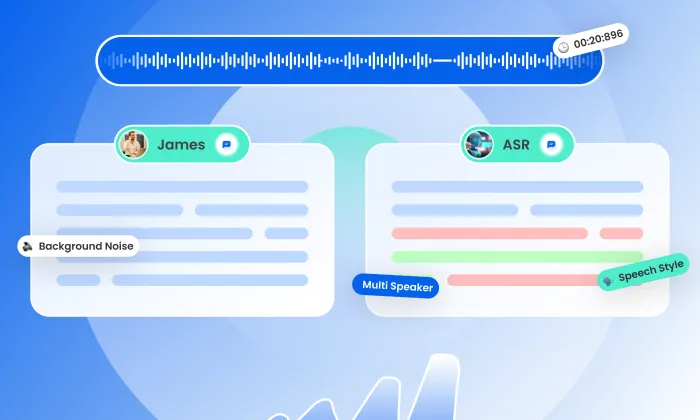
MOS captures general quality perception, but it cannot diagnose specific weaknesses in synthesized speech. A model might achieve a high MOS while still exhibiting issues such as inconsistent rhythm, robotic pacing, or unnatural stress patterns.
Because MOS aggregates listener opinions into a single value, it may hide variations in perception. Some listeners might rate a sample very highly while others detect subtle problems. When averaged, these differences can disappear, giving the impression of consistently high quality even when perceptual issues exist.
Context Determines What Counts as “Good”
A good MOS score depends heavily on the intended application of the TTS system.
Audiobook Narration: Long-form listening requires high naturalness and expressive delivery. In these scenarios, teams often target MOS scores closer to 4.5 or higher to ensure listeners remain engaged over extended sessions.
Virtual Assistants: For short informational responses, clarity and responsiveness are often more important than expressive delivery. A MOS around 4.0 may be acceptable if intelligibility remains strong.
Specialized Applications: Systems designed for education, accessibility tools, or children’s content may require higher perceptual standards because listeners are more sensitive to unnatural speech patterns.
Understanding the use case helps determine whether a MOS score truly reflects acceptable quality.
Breaking MOS Into Attribute-Level Insights
Instead of relying on MOS alone, evaluation frameworks benefit from analyzing speech quality across multiple attributes.
Naturalness: Does the speech sound human-like in rhythm, tone variation, and pacing?
Pronunciation Accuracy: Are words, especially domain-specific terms or proper names, spoken correctly?
Intelligibility: Can listeners clearly understand the speech across different environments and listening conditions?
Attribute-level analysis reveals which specific aspects of speech quality need improvement.
Avoiding the False Confidence of High Scores
A high MOS score can create a false sense of success if teams treat it as the final indicator of quality. Speech may still contain perceptual issues that affect real user experience.
To gain a clearer understanding of system performance, evaluation should combine MOS with additional listening methods such as paired comparisons, attribute-based rubrics, and structured human feedback. These approaches reveal perceptual differences that simple averages may conceal.
Practical Takeaway
MOS is useful as an initial indicator of speech quality, but it should never be the only metric guiding TTS evaluation decisions. Context, application requirements, and attribute-level analysis all play an important role in understanding true system performance.
By combining MOS with structured human evaluation methods, teams can identify subtle weaknesses and refine their models to meet real user expectations.
Conclusion
A “good” MOS score is a starting point rather than a definitive measure of success. Understanding speech quality requires examining how synthesized speech performs across different contexts, listener expectations, and perceptual attributes.
Organizations looking to strengthen their evaluation processes can explore solutions from FutureBeeAI, which support structured human evaluation and attribute-level testing. For teams aiming to build high-quality speech systems that perform reliably in real-world environments, the FutureBeeAI team provides expertise in comprehensive TTS evaluation strategies.
What Else Do People Ask?
 Share this article on


Related AI Articles

Browse Matching Datasets


Acquiring high-quality AI datasets has never been easier!!!
Get in touch with our AI data expert now!
