Author: Jesal Thakkar Founder, FutureBeeAI ·
Reviewer: Praveen Kumar Co-Founder, FutureBeeAI
Last updated: 26/10/26
A customer types "my top-up didn't go through" into your banking app. The assistant replies with steps for a reversed top-up, which is a different problem with a different fix. She tries again, gets the same answer, and calls the contact center. There, a voice bot mishears her account ending in "fifteen" as "fifty" and routes her to the wrong queue. Two channels, two failures, and one customer who now trusts your bank a little less.
None of this is a model architecture problem. It's a data problem. Choosing the best banking dataset for machine learning isn't about finding the biggest corpus. It's about finding data that sounds and types like your customers, in your channels, about your products.
And the stakes are higher now than when most banks ran their first chatbot pilot. So why now?
Why the best banking dataset for machine learning is now a customer experience decision
Conversational AI in banking is no longer an experiment sitting on the side of the website. The U.S. Consumer Financial Protection Bureau estimated that roughly 37% of the U.S. population interacted with a bank's chatbot in 2022, and that all ten of the largest U.S. commercial banks use them. The same report flagged the risks plainly: inaccurate answers, customers stuck in loops, and potential violations of consumer protection law.
Regulators elsewhere are moving in the same direction. The EU AI Act sets transparency obligations for AI systems that interact with people, which puts customer-facing banking assistants squarely in scope. When the assistant gets something wrong, it's no longer just a bad experience. It's a compliance conversation.
At the same time, banks are moving from scripted bots to LLM-based assistants and real-time voice agents. These systems are more capable, which makes the training and evaluation data the deciding factor in how they behave. If you want to see how this plays out across the wider sector, our piece on how AI enables better customer experience in BFSI covers the use cases. Here, we'll focus on what the data underneath needs to look like, starting with chat.
What banking chatbots need from their training data
Banking intents are finer-grained than they look. The widely used BANKING77 benchmark contains 13,083 customer service queries spread across 77 intents, and its authors note that some intents, like "reverted top-up" and "failed top-up", overlap closely. That's the exact confusion from the opening scenario. If your data doesn't separate near-identical intents with enough real examples, your assistant won't either.
Intent labels are only the first layer. A banking chatbot also needs entity annotation for amounts, dates, card types, account references, and merchant names, because the right answer usually depends on the details. It needs multi-turn conversations, since real customers rarely state their full problem in one message. And it needs sentiment and escalation signals, so the assistant knows when a frustrated customer should reach a human instead of another menu.
Then there's how people actually write. Customers misspell, abbreviate, mix languages mid-sentence, and describe products by what they do rather than what the bank calls them. A dataset written by people imitating customers won't capture that. Real agent-customer conversations, like those in our BFSI chat datasets, give the model the vocabulary and messiness it will meet in production.
Chat is only half the picture, though. For most banks, the highest-stakes conversations still happen by voice.
What banking voice AI and ASR need from speech data
Speech recognition in banking runs into problems that clean benchmark audio never shows. Contact center calls are often captured at 8 kHz telephony quality, compressed, and recorded over background noise. A model trained mostly on studio-quality 16 kHz or 48 kHz audio will lose accuracy the moment it meets a real call line. Our guide to sample rate for ASR explains why matching the channel matters as much as the volume of data.
Accents and dialects are the next gap. A study published in PNAS found that five commercial speech recognition systems had an average word error rate of 0.35 for Black speakers compared with 0.19 for white speakers. For a bank, that isn't an abstract fairness metric. It means some customers get misheard more often, repeat themselves more, and abandon calls more. This is why training data diversity is a service quality question, not a box to tick.
Banking speech also carries its own vocabulary. Account numbers, IFSC and IBAN codes, card digits, product names, and amounts spoken in different formats ("fifteen hundred" vs "one thousand five hundred") all need to be represented and transcribed consistently. Two-speaker call recordings, ideally in stereo with agent and customer on separate channels, are what call analytics and agent-assist tools need to learn who said what.
Finally, transcription quality decides how much the audio is worth. Verbatim, time-coded, speaker-wise transcripts with non-speech tags (holds, crosstalk, background noise) let models learn what real calls sound like. Shortcuts here show up later as errors on exactly the calls that matter most.
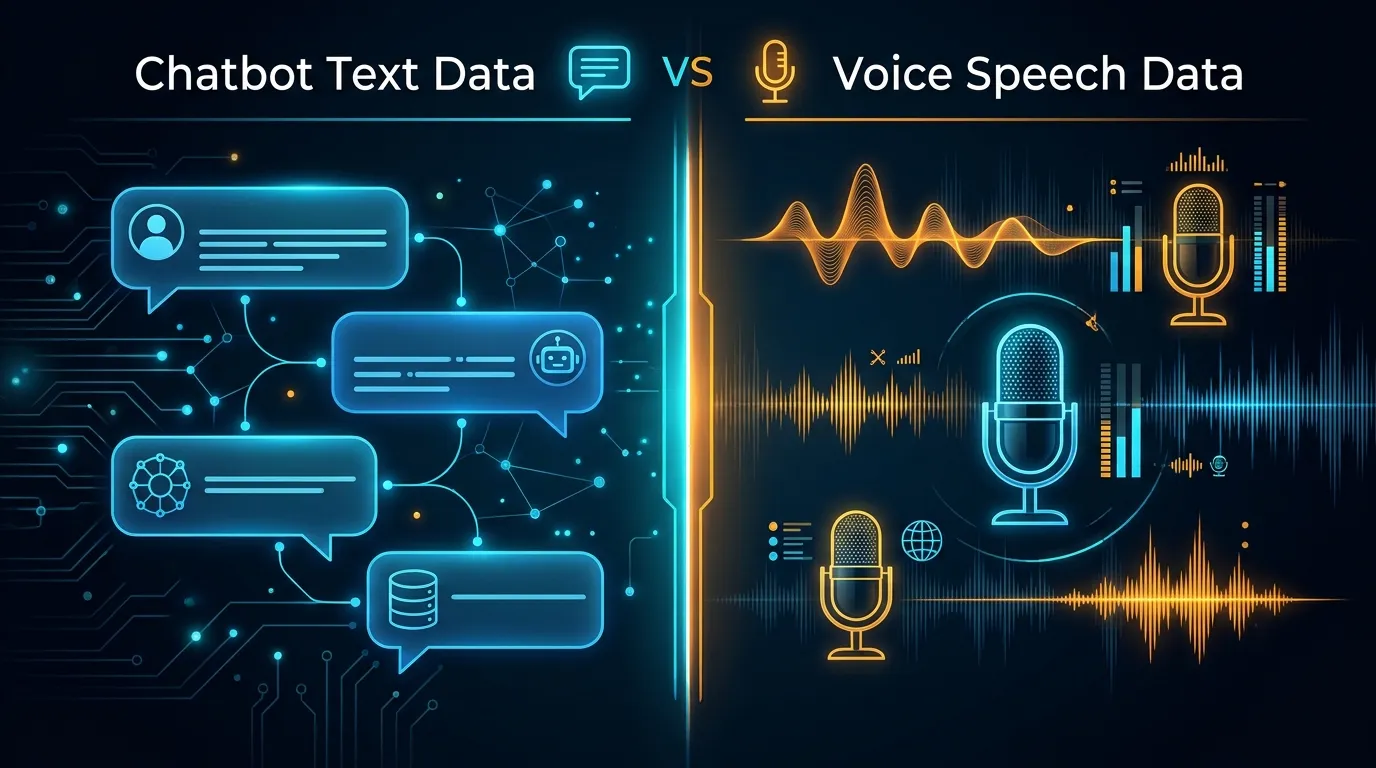
Knowing what you need is the easy part. The harder part is noticing where the usual sources fall short.
Where common thinking about banking datasets fails
The first mistake is treating a public benchmark as a training set. Datasets like BANKING77 are excellent for comparing models, but they're English-only, text-only, and built around one bank's product set. Your customers, languages, and products are different, so the benchmark score tells you little about your production accuracy.
The second is relying on scripted or synthetic conversations alone. Scripted data is useful for coverage of specific phrases, like wake words or voice commands. But customers don't follow scripts. Without spontaneous, real conversations, your model learns how the script writer thinks customers talk.
The third is English-first planning. Many banks serve customers who switch between languages in a single call, or who speak regional varieties of a language the model treats as one. Adding languages after launch is far more expensive than designing for them from the start.
The fourth is treating compliance as cleanup. Financial conversations contain names, account details, and card numbers. If consent wasn't captured when the data was collected, and if personal data wasn't handled properly before annotation, no amount of later filtering makes the dataset safe to build on. Informed consent isn't paperwork. It's what makes the data usable at all.
So how do you tell a good banking dataset from a weak one before you commit budget?
How to evaluate a banking dataset for machine learning: red flags and green flags
Whether you're buying off the shelf or commissioning custom collection, these signals tell you a lot about how the data will behave once your assistant goes live.
Red flags and green flags checklist for evaluating a banking dataset for machine learning
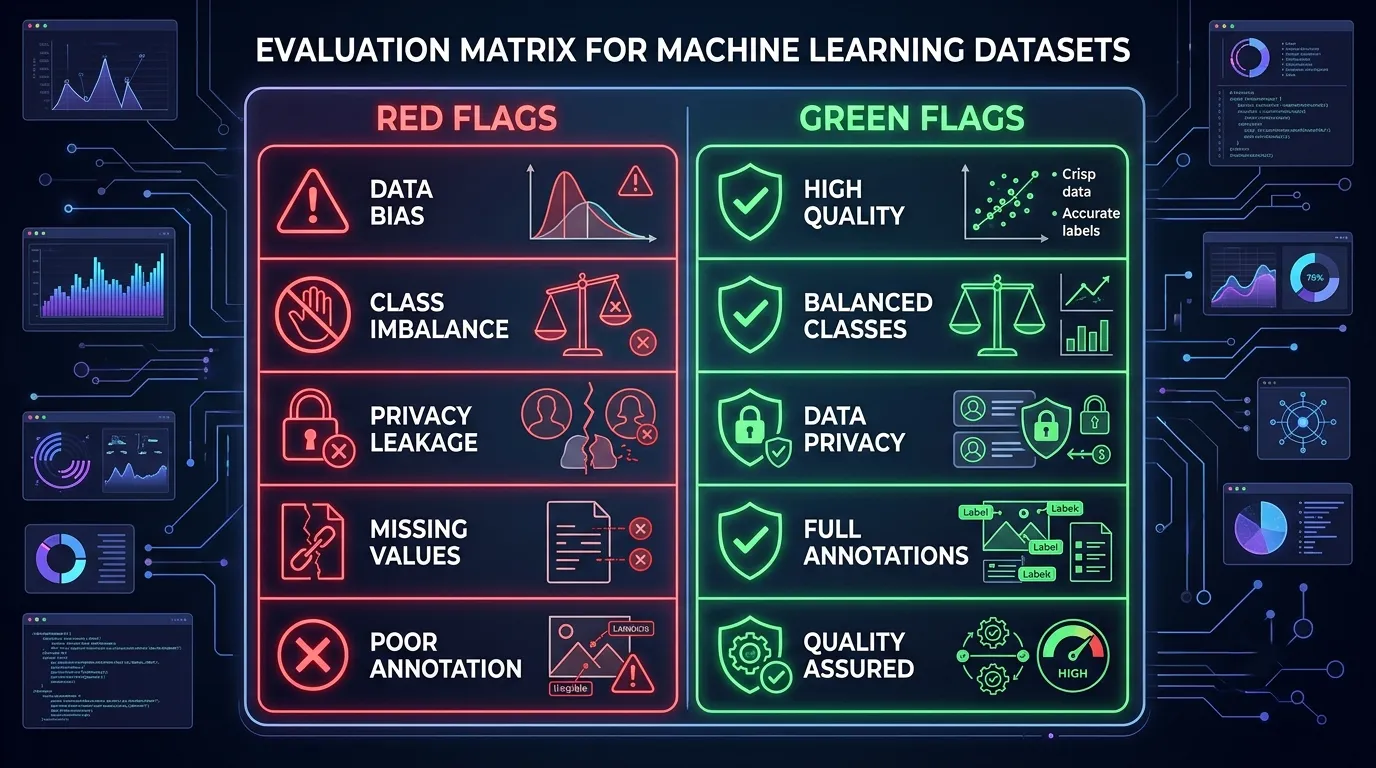
Red flags
No consent or PII handling documentation: If the vendor can't show how consent was captured and how personal data was handled, the legal risk travels into every model you train.
Studio audio only for a call center use case: Clean, wideband recordings won't prepare a model for 8 kHz telephony lines.
Language count with no speaker breakdown: "50 languages" means little without accents, regions, age, and gender distribution per language.
Scripted data presented as conversational: Read-aloud prompts don't capture interruptions, hesitations, or how customers really describe problems.
No sample before purchase: A vendor confident in their data will let you test it against your use case.
Green flags
Real, consented banking conversations: Collected from verified contributors with documented consent and anonymization.
Channel-matched audio: Sample rates, mono or stereo, and recording conditions that match your actual intake channels.
Rich speaker metadata: Age, gender, country, region, and dialect for each speaker, so you can measure coverage against your customer base.
Clear transcription and annotation guidelines: Verbatim, time-coded, speaker-wise transcripts and documented rules for banking entities.
Auditable quality metrics: Word error rate on transcripts, inter-annotator agreement, and multi-layer QA you can inspect.
If a dataset passes this test, the next question is whether you buy it ready-made or build it.
Off-the-shelf or custom: choosing the right path for banking training data
Off-the-shelf (OTS) datasets make sense when your use case is common and your timeline is short. A ready-made call center or chat dataset in your target languages lets you prototype, benchmark, and fine-tune quickly. FutureBeeAI's BFSI dataset catalog includes call center conversations, scripted banking monologues, agent-customer chats, and parallel corpora for banking translation.
Custom collection makes sense when your customers, products, or channels are specific. If you serve a regional market, need a particular dialect mix, or want conversations about your own product names, OTS data will only take you part of the way. With custom data collection, you define the speaker profile, scenarios, and recording conditions, approve a sample first, and receive data in batches you can test as you go.
Most mature teams end up using both: OTS data to get moving, custom data to close the gaps their error analysis reveals. If you're unsure which path fits, the FutureBeeAI team can help you scope it against your actual use case.
The practitioner approach to building banking AI training data
Teams that ship reliable banking assistants tend to follow the same pattern, whatever their stack.
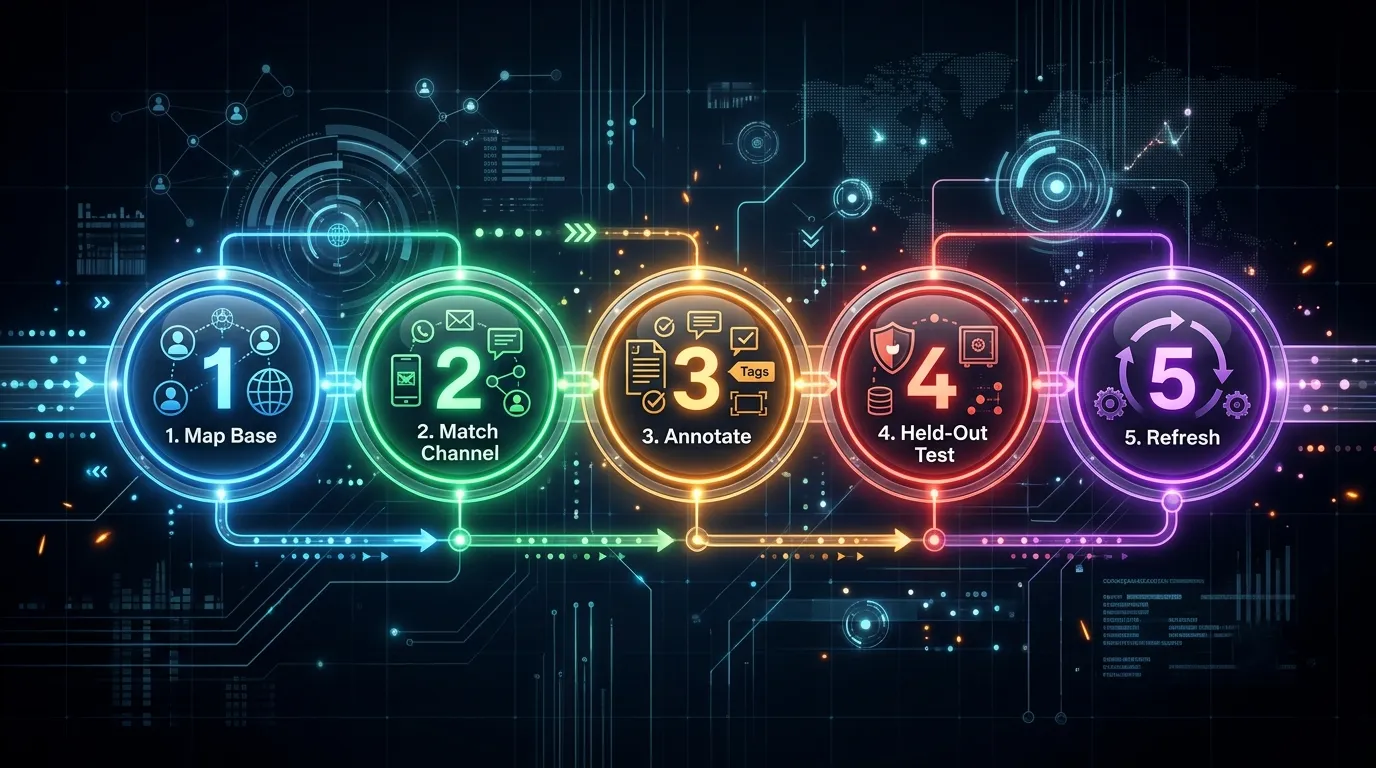
1. Map your real customer base first: List the languages, accents, regions, and channels your customers actually use, and weight them by call and chat volume. This becomes the specification your data has to meet.
2. Match the channel before the volume: Make sure audio sample rates, recording conditions, and chat formats match production. A smaller, channel-matched dataset usually beats a larger, mismatched one.
3. Annotate for banking, not just language: Define clear guidelines for intents that overlap, banking entities, and how spoken numbers are transcribed. Specialist annotation pays off most on exactly these ambiguous cases.
4. Build a held-out test set from real conversations: Evaluate on real, representative calls and chats that never touched training, broken down by accent and language so you can see who the model fails.
5. Refresh as products and customers change: New products, new markets, and new fraud patterns change how customers talk. Feed fresh, consented samples back into training on a regular cycle.
This is how FutureBeeAI approaches banking data. With contributors across 70+ countries and 100+ languages, a catalog of 2000+ datasets, and collection run through the Yugo platform under ISO, GDPR, and HIPAA-aligned controls, the data can reflect the customers your bank actually serves.
Practitioner pipeline for building banking AI training data
Your customers will never see your dataset
Your customers will never read your intent taxonomy or listen to your training audio. What they'll notice is whether the assistant understood them the first time, in their language and their accent, about their actual problem. That's the real test of the best banking dataset for machine learning: not how big it is, but how closely it resembles the people on the other end of the conversation.
The banks that get customer experience AI right won't be the ones with the most data. They'll be the ones whose data looks most like their customers.
If you're planning a banking chatbot, voice bot, or call analytics project, there are two easy next steps. Talk to the FutureBeeAI team about a dataset built around your customers and channels, or explore our ready-to-use datasets to see what's available today.
Frequently Asked Questions
Q. What is the best banking dataset for machine learning?
A. The best banking dataset for machine learning is the one that matches your customers, channels, and use case. For chatbots, that means real agent-customer conversations with fine-grained intent and entity labels. For voice AI, it means channel-matched call center audio with accent coverage and verbatim, time-coded transcripts, all collected with documented consent.
Q. What type of training data does a banking chatbot need?
A. A banking chatbot needs conversational text with fine-grained intent labels, entity annotation for amounts, dates, and account references, multi-turn dialogues, and sentiment or escalation signals. Real customer language, including misspellings and code-switching, matters more than polished scripted examples.
Q. Why does sample rate matter for banking speech recognition?
A. Many contact center calls are recorded at 8 kHz telephony quality, while a lot of available speech data is recorded at 16 kHz or higher. A model trained on mismatched audio tends to lose accuracy on real calls, so training data should match the sample rate and recording conditions of production.
Q. Should I buy an off-the-shelf banking dataset or collect custom data?
A. Off-the-shelf datasets are best for fast prototyping and common use cases. Custom collection is better when you need specific languages, dialects, products, or recording conditions. Many teams start with off-the-shelf data and add custom data to fill gaps found during error analysis.
Q. How do you handle privacy in banking training data?
A. Banking data should be collected with informed consent from contributors, and personal details like names, account numbers, and card numbers should be handled or anonymized before annotation. Collection should follow frameworks like GDPR, with documentation you can share during a compliance review.
 24 October 2023

 Share this article on